The Katchakid Easi-Close Tensioner

The best in pool safety just got better.

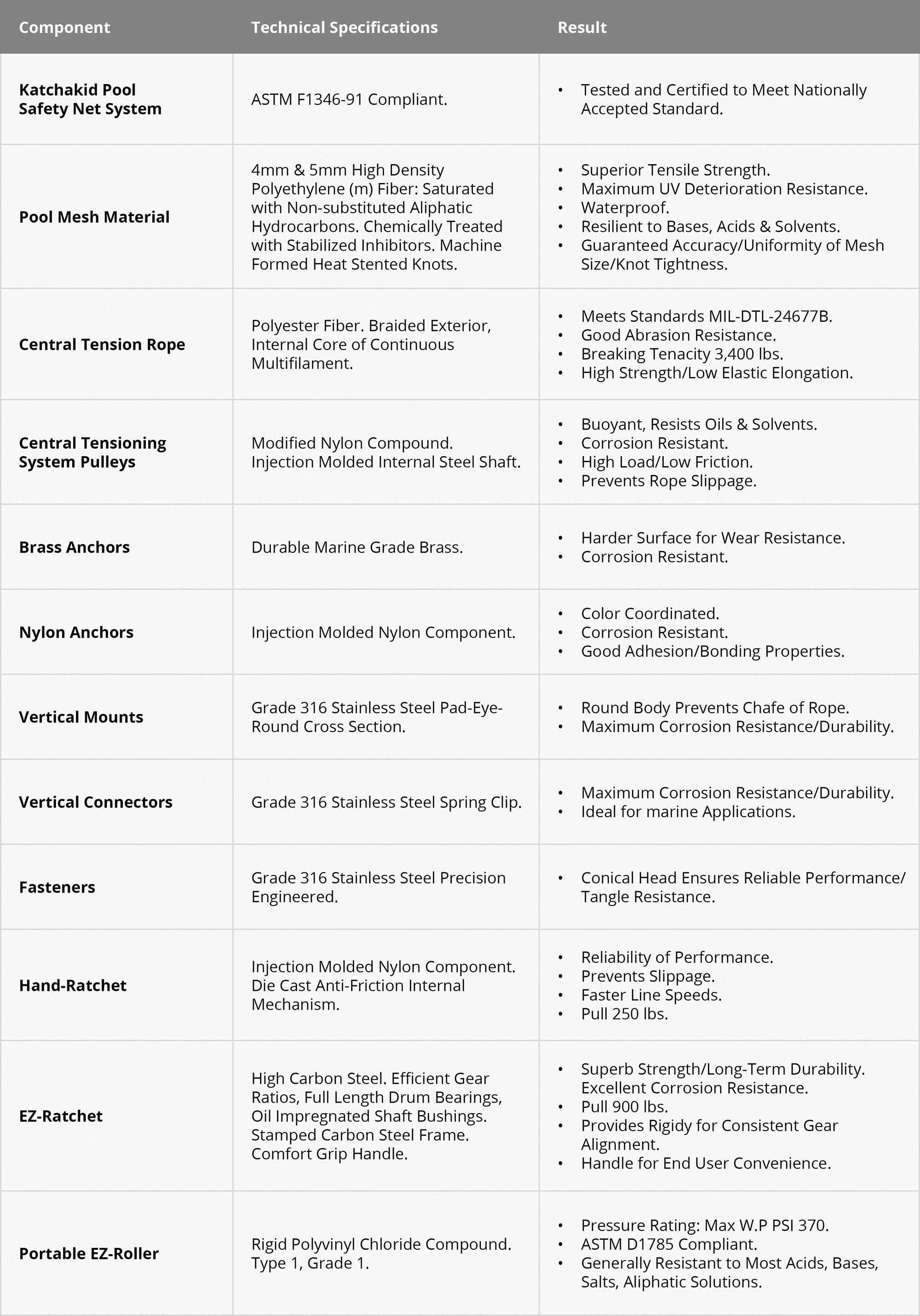
Introducing the newly patented Easi-Close Tenioner. New, stream lined engineering makes the job of tightening the pool net smooth and simple, requiring far less strength and effort than all other existing pool ratchet systems. As a mother, I really appreciate this new feature which makes my life easier.

Advantages:

  • Requires far less space to operate.
  • Minimal strain to tighten or release your Central Tensioning System.
  • No pulling or tugging.
  • Compact and aesthetically pleasing.
  • The new Easi-Close Tensioner is a breeze to install and use.

Another great innovation from the inventor of pool safety nets.

Leave a Comment

What Does Drowning Look Like?

At a Katchakid meeting the other day we were all discussing drowning and near drowning incidents when Mary, The Pool Safety Mom, asked us “what does drowning look like?” I thought this would be a great topic for this blog because it is something not often discussed and many children die because their signs of distress are misread. After all, how many times do we read of children dying in the midst of busy swimming pools?

According to the experts the Hollywood depicted drownings with all the thrashing, yelling and drama are false with the realty being deceptively silent and splash free. (Of course that doesn’t mean that anyone waving or calling for help does not need assistance.)

So what should we look for? According to “It Doesn’t Look Like They’re Drowning” By Aviation Survival Technician First Class Mario Vittone and Francesco A. Pia, Ph.D the following are the characteristics of what they call “The instinctive Drowning Response”

“1. Except in rare circumstances, drowning people are physiologically unable to call out for help. The respiratory system was designed for breathing. Speech is the secondary, or overlaid, function. Breathing must be fulfilled, before speech occurs.

2. Drowning people’s mouths alternately sink below and reappear above the surface of the water. The mouths of drowning people are not above the surface of the water long enough for them to exhale, inhale, and call out for help. When the drowning people’s mouths are above the surface, they exhale and inhale quickly as their mouths start to sink below the surface of the water.

3. Drowning people cannot wave for help. Nature instinctively forces them to extend their arms laterally and press down on the water’s surface. Pressing down on the surface of the water permits drowning people to leverage their bodies so they can lift their mouths out of the water to breathe.

4. Throughout the Instinctive Drowning Response, drowning people cannot voluntarily control their arm movements. Physiologically, drowning people who are struggling on the surface of the water cannot stop drowning and perform voluntary movements such as waving for help, moving toward a rescuer, or reaching out for a piece of rescue equipment.

5. From beginning to end of the Instinctive Drowning Response people’s bodies remain upright in the water, with no evidence of a supporting kick. Unless rescued by a trained lifeguard, these drowning people can only struggle on the surface of the water from 20 to 60 seconds before submersion occurs.”

I have been told many times to look out for a child “climbing a ladder” vertical in position, arms extended, little or no leg movements and head facing upwards. These children are unable to launch off the bottom of the pool or break the waters surface. Furthermore it is often silent and the water is calm.

Comments (1)

What Is A Central Tension System?

Katchakid CEO Blair Esson invented and patented the first central tension system close to 30 years ago as a means to get a pool safety net to the required tension without excessive physical exertion. Like tightening a drawstring bag the concept is to pull up and tighten a pool net from the center point of the pool through a series pulleys.

The Katchakid pool safety net has a built in centrally tensioned system (CTS) that can be adjusted from tight to very tight and is designed in such a way that most children under the age of 12 years cannot remove it. The series of pulley’s are set in a circular fashion, which open and close. The correct configuration and size of the CTS together with a necessary amount of pulleys determine a pool nets efficiency. The Katchakid uses an average of 12 to 16 pulleys per CTS.

Swimming pools with well-defined midpoints usually require one CTS whereas pools of unusual shapes such as L’s, figure 8’s, Lap-pools etc… will require more.

Comments (2)

ASTM Standard F1346-91 Compliant Pool Safety Covers.

Who and What Is ASTM International?

Originated in 1898 by a group of railway engineers, to deal with issues concerning their steel rails, ASTM International has become one of the largest classification and standards developing organization in the world. Standards and classifications are developed within voluntary member committees. ASTM International performs no part in approving, sanctioning or enforcing compliance with its standards. The standards become mandated when referenced by a society, association, or government. To demonstrate a product fufills the terms of a standard a product can be tested by an independent testing laboratory. The laboratory will then issue a full report with confirmation of compliance.

Why Is The ASTM F1346-91 Standard Important?

ASTM F1346 - 91 Standard Performance Specification for Safety Covers and Labeling Requirements for All Covers for Swimming Pools, Spas and Hot Tubs. ASTM International developed this standard to reduce the risk of drowning to children of less than 5 years of age. This standard is used in many States and Cities mandated pool barrier codes as well as referenced nationally by day-care, adoption and fostering agencies.

Some of the qualifications for ASTM specification F1346-91 include:

  • The static load test for weight support. The cover should be able to hold a weight of at least 485lbs (2 adults and 1 child) to permit rescue operation.
  • Perimeter Deflection Tests for entry or entrapment between the cover and the side of the pool. The cover must demonstrate that any opening is sufficiently small and strong enough to prevent the test object being passed through.
  • The Surface Drainage Test which safeguards against a dangerous amount of water collecting on the cover’s surface.
  • Labeling requirements must include basic consumer information such as the warranty information, the appropriate warnings as described in the standard, and acknowledge the product as a safety cover.

How Can You Tell If A Cover Meets The ASTM F1346-91 Standard?

The Pool cover companies website, literature and brochures will state ASTM F1346-91 safety cover compliant. The pool cover itself will have the correct labels attached and the company will be able to show laboratory reports to further prove their covers compliance to the standard.

ASTM F1346-91 Compliancy Ensures You Of A Quality Pool Cover.

All pool covers are supplementary pool safety aids and not a substitute for the undivided and constant supervision of an adult. Pool covers can never replace adult supervision nor can they be a guarantee against drowning or other accidents. Always replace your cover after swimming. Experts agree that multiple layers of protection offer the best protection against drowning and near drowning incidents. The most at risk are children under 5 years of age so always be extra vigilant with children in this age group.

The Katchakid Is ASTM F1346-91 Compliant.

The Katchakid pool net, manufactured in Houston, Texas by Katchakid Inc. is compliant with ASTM standard F1346-91 for manual safety covers. The Katchakid pool safety net meets all the criteria for the standard’s demanding series of performance tests and labeling requirements. While already a quality and time tested product, conforming to the ASTM’s code further provides owners of the Katchakid assurance that they have one of the best forms of pool protection assisting to reduce the drowning risk of small children.

Comments (4)

Pets and Pool Safety Nets.

Katchakid pool safety nets are often used to protect animals; an older dog going blind, a new puppy or pet owner nervous about leaving a pet in a yard with an un-protected pool. Preventing a dog from having access to a pool may prevent a build up of hair in the water and nail damage, scratches to pool walls.

When a dog falls into a pool or decides to swim they can get into trouble when they can’t find the pool steps to get themselves back out. Studies into dogs that have drowned show a high percentage of dogs have worn their front nails down by scrabbling to get a grip up onto the poolside. Some dog breeds naturally stay away from the pool while others such as Labradors and Alsatians are naturally attracted to water.  It depends on which dog breed and if the dog is drawn to the water as to whether an investment into a Katchakid pool safety net is worthwhile.

The mesh square size Katchakid uses should safeguard a puppy from a larger breed of dogs but not a puppy from a smaller dog breed from an incident with a pool. So extra care is needed with smaller breeds. There have not been any reported occurrences of dogs getting tangled up in pool nets. A dog’s dexterity is surprising; I have seen many breeds of dog traverse a net in seconds.

Pool safety nets are susceptible to animal chews. Some dogs will chew through a net chasing after a toy or ball that has fallen in. We often see a path of damage following your pools water flow so keep animal toys away from the pool area. If a dog persists in chewing on a net there are some products readily available from pet stores such as citronella or bitter apple sprays that may help. Nets stored in garages may become nesting material to rodents so if you are storing a pool safety net consider baling and hanging it from a garage roof.

Minor damage to pool safety nets can be mended by replicating mesh squares with netting braid. For extensive damage contact your pool net manufacturer for assessment, repair and to test the integrity of your pool net.

Repairing A Pool Safety Net.

Comments (5)

What Height is Best In A Pool Fence?

There are many contributing factors to installing an effective and reliable pool fence, such as the climability of the material, its construction, and how and where it is installed. The purpose of this blog is not to discuss these features but to discuss the actual height of the fence. So the question is what height should a fence be 4ft / 48inches or 5ft / 60inches in height?

Currently the below organizations recommend the following heights: (this is the measurement taken from each side of the fence from the ground up)

American Academy of Pediatrics – At least 48”*

Consumer Safety Product Commission – At Least 48” *

National Drowning Prevention Alliance – 60” *

Safe Kids USA – 60” *

Most of the 48inch height recommendations are from older studies and reports. New thought is that 60inches is more effective and most municipalities, daycare, adoption and fostering agencies now require this as a minimum height for compliance.

With regards to strength and robustness, as long as the fence is in good repair, is of sound construction and is installed correctly there is negligible difference between the two heights. It is true that with concentric, tension based fencing the 4ft height is slightly tighter with there being a little more “give” in the 5ft fence. According to Javier Ibarra, Katchakid Inc’s fencing expert more experience is needed to fit a 5ft concentric, tension based fence as the angles required make it a more technical installation. In windy areas obviously the higher the fence the more prone it is to wind damage.

There is a train of thought that if a child can climb a 4ft fence then they could certainly climb a 5ft fence. This is probably true however I think that children are like adults in that they weigh up the odds of a task being within their capabilities. If you consider that an average 4 year old is approximately 36 – 39inches tall that doesn’t leave much difference between them and a 48inch fence, add another 12inches and I think they would feel their probability of successfully scaling that fence significantly reduced. This is conjecture on my part but as a mother of 3 tall and rambunctious children I feel confident in that statement.

I have heard many people say that a 4ft fence looks better. This is probably true as your eye level looks over a 4ft fence unlike a 5ft fence that is looked at. But the common aim we are working towards is child pool safety. Pool safety companies are not landscaping companies. Undoubtedly a nice pot plant will enhance your pool much better that a fence but that is not what we are here for.

Realistically choosing a fence height will most likely depend on the children; boys or girls, 1 child or multiples, obedient and compliant children versus boisterous more confident children, a child that will rather than one that won’t. My own personal leaning is towards a 5ft fence as, as far as I am concerned, with pool safety bigger, better and more is best!

1.American Academy Of Pediatrics:

http://www.aap.org/family/tipppool.htm

2.Safety Barrier Guidelines for Home Pools. U.S. Consumer Product Safety Commission. 362.

3. National Drowning Prevention Alliance:

http://www.ndpa.org/tips/layers.htm

4.Safe Kids USA:

http://www.safekids.org/safety-basics/safety-resources-by-risk-area/drowning/

5.California Swimming Pool Safety Act. California Legislation: AB 3305 (925).

Comments (3)

Mary Ann Downing, Pool Safety Mom

Drowning Prevention is Everyone’s Business!

“Pool Safety Mom”… Mary Ann Downing became focused on drowning prevention in the late ‘70s (or maybe earlier if you count her first “Junior Lifesaving” class …!) She has a teaching degree in Health & Physical Education with an emphasis in Aquatics from Indiana University of PA. (IUP) She was a YMCA Aquatic Director, worked in the fitness industry, then went into the life and health insurance field.

Fast forward 25 years from college…and backyard swimming pool drowning is still an epidemic targeting small children under the age of 5. Mary became passionate about swimming pool safety when, as the mother of 2 young daughters, she bought a house with a pool. Her quest to keep her own children safe in the backyard brought an opportunity to tell other pool owning families about products and strategies to prevent drowning. She started her business: Pool Safety Solutions, Inc, and her mission is to “provide parents and pool owners with information, products and solutions to keep kids safe around backyard swimming pools”. She acts as a manufacturer’s representative for industry leaders in pool products including Katchakid.

Since 2003 Mary has met with more than 1000 pool owners in their own backyards, helping create a safe (and beautiful) area using all of the available pool safety barriers. Her conversations always include the “ABCs of Drowning Prevention” and the Water Watcher Program. Mary has a passion for spreading the message to those with the power and influence to prevent drownings. She has been asked to speak to Women’s groups, Mom’s Clubs, to hospital based classes, Lifeguards, Rotary and Kiwanis Clubs, schools, and pool professionals. Her “Pool Safety Mom” presentations offer suggestions to empower pool owners to do what they can to control and promote a safe swimming environment in their own backyards . Ask for a “pool safety makeover” to keep kids safe! Mary has been a presenter at the Atlantic City Pool and Spa Show and the National Drowning Prevention Symposium. She volunteers for the American Red Cross as a CPR instructor.

Ms. Downing currently lives in San Diego, CA with her two daughters. She is a board member of the National Drowning Prevention Alliance, a Member of the Drowning Prevention Foundation. She belongs to the Association for Pool and Spa Professionals, is a supporter of the San Diego Chapter of IPSSA and serves on the Board of Directors for The Rancho Santa Fe Business & Professional Women. She is a Guardian Life Insurance representative, and now a member of the SWIM (South West Independent Marketing) TEAM.

Mary Ann Downing
Pool Safety Solutions
Katchakid Sales Executive
Lic# 78459

Comments (2)

Mean Mom Rules by the Pool

Cannonball competition; Fly off the waterfall; Longest jump over little brother; Duck!

Summertime and everybody heads for the backyard pool. It’s every kid’s dream and every mom’s nightmare! We don’t want to ruin the fun of summer. But how do we let them have fun and at the same time keep them from ending up in the ER with stitches in their head or worse?

Nobody wants to be called a spoil sport or mean mom. Wait. That’s not quite true. The answer to allowing the dream while preventing it from becoming a nightmare is actually to be just that; a mean mom; a “mean pool safety mom”!

What is a “mean pool safety mom”? The concept is the result of a meeting between 2 San Diego moms: Mean Mom’s Club President-Maureen LoBue and the Pool Safety Mom Mary Ann Downing. Each has the same goal: take charge to keep our kids safe by setting realistic boundaries and enforcing those boundaries. A mean pool safety mom knows the ABCs of drowning prevention, and follows three simple steps to create and enforce a safe summer in the water.

These three steps are built on the two most critical focuses of a mean mom: safety and structure. Mean Mom’s Club: The Mom’s Rule Book*, a reference guide to becoming a take charge mom based on these two focuses, translates perfectly to becoming a mean pool safety mom.

The President of the Mean Mom’s Club is prepared to deputize all moms as “mean pool safety moms”, by following these three steps:

First, know what safety means at different stages of development. “See ‘em to save ‘em” should be the underlying theme, adjusted for each stage**.

Toddlers - keep them from hurting themselves as they start to venture out on their own in their physical world. Keep toddlers away from danger - the street, the stairs, the stove, and especially the pool. Keep that pool closed any time it’s not supervised and follow touch supervision: “If you can’t reach them, you can’t save them”. Toddlers are faster than a race car driver on the Indy 500. So, keep them securely away from the pool and within arms reach in or near the pool.

Pre-school kids - allow them to use their imagination while keeping them in reality when it counts. The pool safety rule “never swim without a grown-up” is key, with the supervising adult in or by the poolside. Mary the Pool Safety Mom recalls pre-schoolers in beginner swim lessons nodding, yes, they would jump in like a lifeguard to save someone. A mean pool safety mom knows that no matter how many lessons, no child is drown-proof!

School-age kids - give them guidelines for how far they can venture out not just physically, but also socially. Every kid knows the fire safety rule “stop, drop and roll”, but the pool rule they seem to remember…”don’t pee in the pool”. Explain water safety rules clearly, such swimming only with an adult, and enforce them without fail. There can be no idle threats. When a friend dares your kid to jump over little brother, he should respond with “No way! You can’t get away with anything with MY mom!”

Teenagers - keep them from situations that will require them to make judgments they’re not ready for. When the friend says it’s ok to go in the pool without an adult, it is tempting to follow along because of peer pressure and because teens see themselves as omnipotent; accidents won’t happen to them. Well accidents do happen when teens do dumb/stupid things, like dive into shallow water or off the waterfall. When teens are injured others may not even realize the person is hurt or the extent of the injury.

Second, set boundaries to keep them safe. Pool safety requires layers of physical barriers and protective boundaries. Building code often requires, and experts in drowning prevention recommend, a fence that separates the pool from the house, a pool safety cover and alarms***.

Close the pool. That sounds easy enough. But leave it to kids to find the gray in that black and white statement. The pool is closed means no one goes in the water. Imagine Mary the Pool Safety Mom’s surprise looking out on the “closed pool” to find her honor roll Girl Scout floating leisurely on a blow up raft catching a few rays. On confronting her with the boundary rule to not go in the pool or in the water, the response was…are you ready for this?…“I wasn’t in the water, I was on the raft!”

The moral of the story is that it is up to the mean pool safety mom and dad to truly close the pool. Use layers that completely block access to the water. Install a fence with a self closing self latching gate, or a safety cover that meets American Society for Testing and Materials (ASTM) standards. Use
alarms on doors leading to the pool, around the perimeter of the pool, in the pool or on the kids. Remember how fast, imaginative, and adventurous they are.

Third, create a safety plan for the open pool and stick to it, even when that makes you a “mean mom”. That’s your job! The plan must include:

• Water watcher duty – Designate an adult to oversee the pool at all times. That means eyes on the water, not on the grill, but on the water and each person in or near the water. He/she needs to be able to perform a rescue if necessary, which rules out great grandpa who would need to shuffle to poolside with his walker. The designated water watcher is the lifeguard. Hey great idea for the next pool party - hire a lifeguard.
• Know the swimming ability of each person. If you ask a kid if he can swim, what will his answer be? Of course it will be yes. Know what their skills really are. Then if you see the poor swimmer getting into deep water you can respond before they get into trouble.
• Set rules based on ages/abilities of the swimmers that will protect them from themselves (remember the developmental levels in step 1). But remember to pick your battles. No need to break up every splashfest, but prevent behavior that could be injury causing.
• Put on life jackets rather than the cute little arm floaties that are likely to float away without the little swimmer.
• Have the proper equipment, know how to use it and reach it immediately. A rescue/life hook is a great $20 idea for every pool. Let’s face it; you may become the lifeguard in a crisis!
• The pool must be safe and the water clear. Ask your pool expert to check the drain covers. This is a critical safety issue and must be routinely checked to prevent tragic injuries and drowning caused by entrapment or suction.
• Have an emergency plan. We don’t want to believe that it can happen, but we know that in fact it can. Over 80 California children ages 1-2 drown each year (CDC 2005). Moms should know CPR and first aid. Be sure someone at the pool can perform CPR. Know who would call 911 if
necessary, and use the house phone so that the 911 operator can track the location of the call.

It’s just not enough to say “watch the kids by the pool”. Follow the ABCs; Adult Supervision, Barriers, and learn CPR and how to swim. Follow the three steps; know safety at each stage, set boundaries, and create a safety plan for the open pool.

And now you can be the best prevention of all by becoming a mean pool safety mom.

Excellent prevention resources are available to prevent swimming pool and drowning accidents+

——————————————————————————-

* The author, Maureen LoBue, M.Ed., has combined both personal and professional experience to create Mean Mom’s Club: The Mom’s Rule Book. The purpose is to provide a common sense foundation for parents to take charge of any given situation by using the rules to plan ahead. The 7 rules prepare parents to deal with situations at different ages for different children, using their own parenting style.

For more information, contact: Maureen LoBue M.Ed, President of the Mean Mom’s Club, meanmom(at)meanmomsclub.com, www.meanmomsclub.com

Contributing author is “Pool Safety Mom” Mary Ann Downing, the owner of Pool Safety Solutions in San Diego CA. Since 2003, Mary has been meeting with pool owning parents to help develop backyard pool safety strategies with awareness and equipment like Katchakid’s removable pool safety fence and pool safety net. Mary’s aquatic background began decades ago with the American Red Cross and YMCA. She is a member of the National Drowning Prevention Alliance, Drowning Prevention Foundation, IPSSA and SafeKids San Diego.

Contact Mary at marydowning(at)san.rr.com.

** Texas Dept of Family and Protective Services, www.seeandsave.org
*** The “Drowning Prevention Foundation, www.dpf.org
+ Consumer Product Safety Commission, http://www.cpsc.gov
California DDS, http://www.dds.ca.gov
American Red Cross http://www.redcross.org
ABCs of pool safety http://www.abcpoolsafety.org/drowning.html
YMCA http://www.ymca.net
USLA http://www.usla.org

Comments (6)

Remember 4 for a Safe 4th

A Note from the Pool Safety Mom

It’s almost the 4th of July. Between barbeques and picnics and backyard parties, here’s a reminder to please think and BE SAFE around water!

Every year, the 4th of July summer holiday turns tragic for some family because a toddler drowns, usually in the backyard pool, often when one parent thought the other was “watching”. Combine the ABCs of Drowning Prevention for year round pool safety:

Remember these 4 for the 4th:

Supervise!- Adult Supervision must be constant, free of distractions and hands on! Hire a lifeguard or use a Water Watcher!
Secure!- Barriers save lives, every pool should be fenced and covered. Close the pool when the party is over!
Save a life!- CPR can change the outcome of an immersion accident. Every adult should learn CPR.
SWIM and Survive! Every caregiver should learn to swim, and every child can benefit from swim lessons and survival swim training.

Research by National SAFE KIDS shows that only the combination of constant competent adult supervision, a safe pool environment, safer children and an emergency action plan will prevent drowning.

The “Pool Safety Mom” lesson for the 4th- 4 things- Supervise the kids, Secure the pool, Save a Life with CPR and everyone learn to SWIM!

Comments (9)

Stop, Drop and Watch the Water!

A Note from the Pool Safety Mom

Every kid knows the fire safety rule “Stop, Drop and Roll”! Why is that? Well, thanks to the efforts of Firefighters and Fire Safety Educators everywhere preschool kids have been taught some fire safety basics!

Ask that same little one to tell you a swimming pool safety rule and you will get either “don’t run” or more typically “don’t pee in the pool”!
Go ahead and ask!

So let’s come up with a good one to remember for pool safety! Email your “pool safety rules and rhymes” to the Pool Safety Mom.

Because drowning is the number one fatal injury of children ages 1-4, we need to keep kids away from the pool unless they are vigilantly supervised. Backyard swimming pool drowning is a threat especially to toddlers. The CDC reported 81 children, (ages 1-4) drowned in California in 2005. Nationally, 65% of preschooler drownings occurs in the child’s own home pool, the rest at pools of friends, neighbors or relatives. (US CPSC)

It’s up to adults to keep toddlers away from the pool and to vigilantly supervise children near water. Every parent or guardian must supervise their own children, and assign a “Water Watcher” as an additional layer of protection– like a backyard lifeguard.

So, the Pool Safety Mom’s version of the Stop, Drop and Roll rule….is really for Adults…

“STOP” right there where you can see the pool and
“DROP” what you are doing…and
“WATCH the WATER”!

Backyard Swimming Pool Drowning is preventable with a multifaceted approach that includes Adult Supervision, layers of protection and physical Barriers, learning CPR and what to do in a crisis, and everyone should learn SWIM!


Comments (3)